
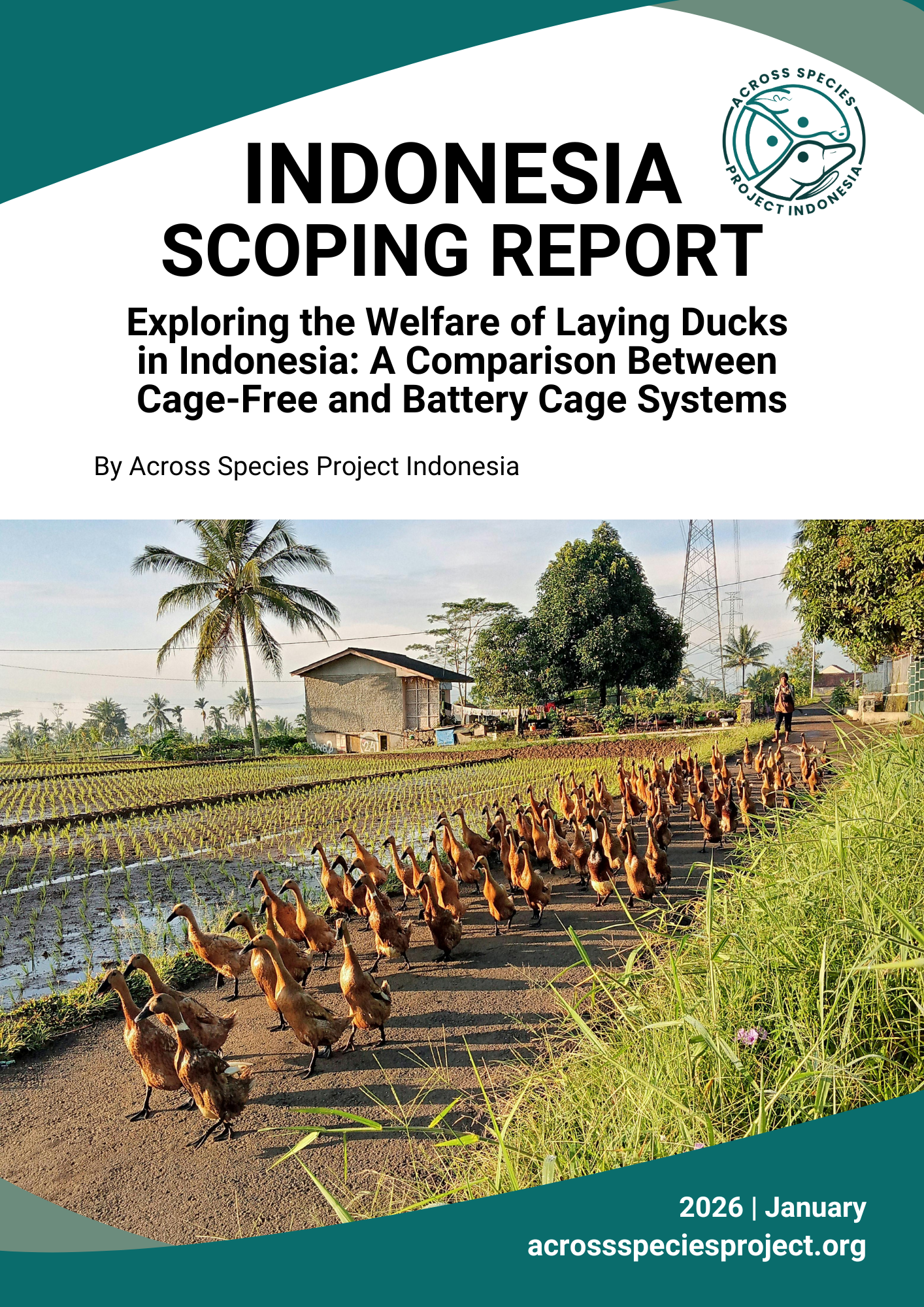
INDONESIA SCOPING REPORT: Exploring the Welfare of Laying Ducks in Indonesia – A Comparison Between Cage-Free and Battery Cage Systems
According to the Central Statistics Agency (BPS), the duck population in Indonesia reached approximately 43 million in 2024, with an estimated production of around 269,310 tons of duck eggs and 38,256 tons of duck meat. Globally, Indonesia ranks fourth in terms of duck population based on FAO data cited by Worldostats. The five largest duck egg– producing provinces in Indonesia are West Java, East Java, South Sulawesi, Central Java, and South Kalimantan. The domestic duck egg market shows increasing demand, with a projected annual growth rate of 6.95%, in line with the growing global consumption of duck products, particularly in Asia. In response to this economic opportunity, several duck farmers—particularly in Blitar Regency and the Special Region of Yogyakarta—have begun shifting from traditional or extensive systems to battery cage system as a strategy to increase productivity. However, this practice often overlooks fundamental animal welfare principles.
Across Species Project Indonesia (ASPI) aims to improve the welfare of farmed animals, particularly laying ducks, by promoting sustainable farming practices that prioritize animal welfare in Indonesia. This report is part of ASPI’s ongoing efforts to understand and enhance the welfare conditions of laying ducks across different farming systems. We assessed 36 farms in East Java and the Special Region of Yogyakarta, covering both battery cage and cage-free systems. In East Java, data collection focused on Blitar Regency—an area with the highest duck egg production in the province, where total duck egg production reaches 46,572 tons. This study included 8 battery cage farms and 13 cage-free farms across four sub-districts: Ponggok, Nglegok, Kademangan, and Wlingi. In the Special Region of Yogyakarta, a province with approximately 3,141 tons of duck egg production, the study covered three regencies (Kulon Progo, Bantul, and Sleman), comprising 4 battery cage farms and 11 cage-free farms.
This study adopts an observational and comparative approach to evaluate the welfare of laying ducks in two primary farming systems: cage-free and battery cage. Data collection was conducted through direct field observations, quantitative measurements, visual documentation, and semi-structured interviews with farmers.
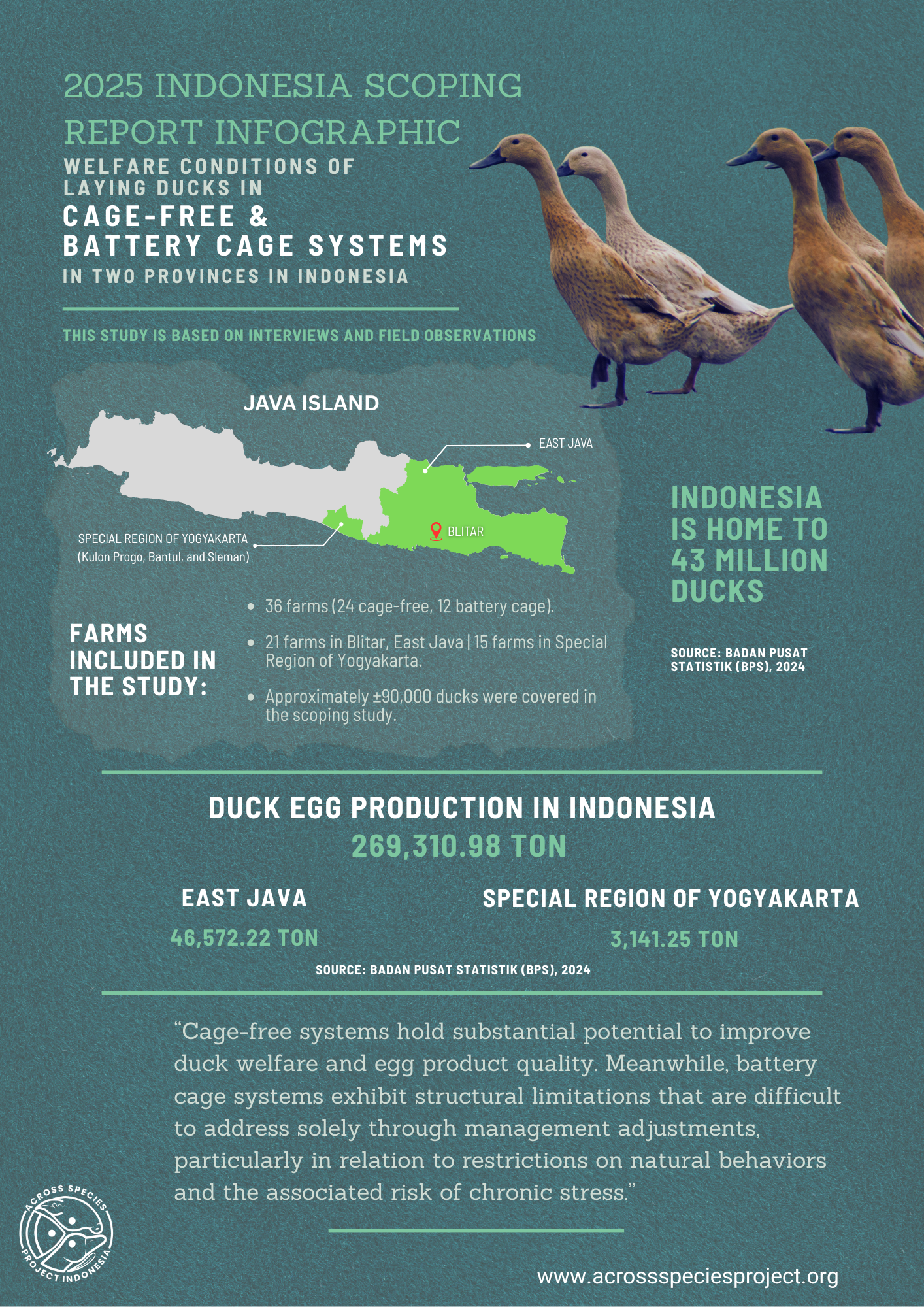
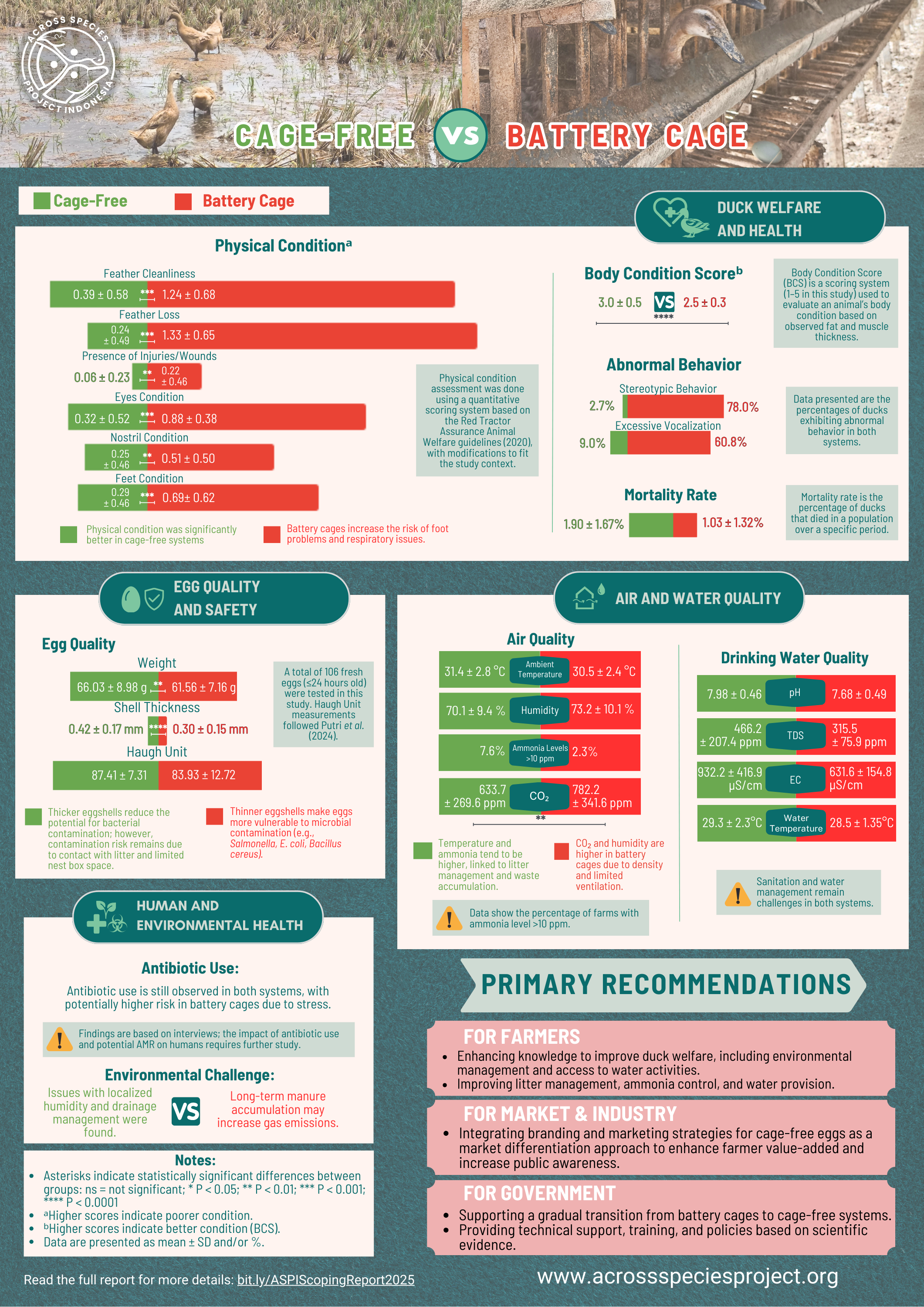
2025 Indonesia Scoping Report Infographic

Hi,
I would like to connect with the author of this piece and if your organisation has any ongoing project on Duck welfare, I’d appreciate a connect with the same. I work in the Capacity building working group of AfA and we are looking to find meaningful connections for one of the Asia based organisations that has started to work on duck welfare reform in Vietnam.
I will be grateful if someone gets in touch to share from your organisation.